
One State with Courage is a Majority
Minnesotans are changing the nation; now they must change the state

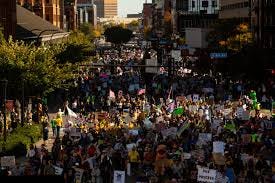
In 1963, four young Blacks sat at the lunch counter of the then-segregated McCrory’s Five and Dime in St. Augustine, FL. The four teenagers were arrested and offered a deal. If they promised to never protest again, charges would be dropped. They rejected the deal. The two young men were sent to the kind of Florida reform school Colson Whitehead wrote about in his novel, “The Nickel Boys.” It was a place not for rehabilitation, but for brutal torture and corruption. It took six months before public outrage forced state officials to release the two.
A sign marks the site. On it is a phrase that resonates today:
“One person with courage is a majority.”
Minnesotans by the thousands have shown what one state with people of great courage can achieve. Minnesotans did more than just stand up to the Trump Administration. They reached across the boundaries of neighborhoods, age, wealth, race and maybe even politics to forge a common bond. Minnesotans rallied to stand up for America’s core values and for their neighbors.
Minnesotans have raised the conscience of a nation. The courage of one state has become the majority. Public opinion has shifted against the harshest immigration policies of the Trump Administration. Even some of the most partisan now are demanding that the United States find a balance in immigration policies. Yes, the U.S. should deport those who commit serious crimes, secure its borders and control who enters the country. But the U.S. always should be a country that welcomes “the huddled masses yearning to be free.”
We are a nation of immigrants, one that depends on the contributions newcomers make to the vitality of the nation. The libertarian CATO Institute, reflecting the conclusions reached by many analyses, found that in the years 1994 to 2023, immigrants paid more in taxes than they received in benefits. They generated nearly $10.6 trillion more in federal, state, and local taxes than they induced in total government spending.
Other studies have found that as of 2025, 46% of Fortune 500 companies were started by first generation immigrants or their children. An estimated 55% of billion-dollar business start-ups are founded by immigrants; 44% of these largest new businesses were launched by first generation immigrants.
ICE agents are maintaining a presence in Minnesota with reports that their focus will shift to the suburbs and rural communities. The energy and dedication of Minnesotans that have brought at least a measure of accountability to ICE will continue.
More is needed. President Trump is trying to cut a St. Augustine-type deal with Minnesota: stop protesting the cruelty and abuses of ICE or more “retribution” will be on the way.
Minnesotans will reject the deal, but what they do next will define the future. Minnesotans stood up to ICE and Trump and changed the attitudes of the nation; now they must stay engaged to change the politics and policies of the state.
The whistles that alerted people to the excesses of ICE enforcement now must become the voices of a politically-engaged public. Yes, the perpetrators of fraud must be held accountable and measures put in place to safeguard public dollars. The equally important challenge, though, is to assure that Minnesota is a state in which public programs are effective, efficient and responsible while government delivers on its role of helping people at times in their lives when they are most vulnerable. Finding blame for fraud is easy especially if the targets sometimes are more partisan than valid. Finding solutions to maintain an affordable safety net for the truly needy is more difficult but equally urgent.
The legislature, like society in general, is becoming more partisan and lines already are drawn in the legislature over the response to the damage created by the ICE surge. Rep. Mary Franson, a Republican from rural west-central Minnesota, echoing many others in the GOP, declared in no uncertain terms her opposition to a state fund to assist small businesses harmed by the ICE surge: “I ain’t voting for a bailout.” But what of the farmers in Rep. Franson’s district who are expecting to share in the $12 billion Trump bailout to compensate for his disastrous trade policies? Aren’t the small businesses devastated by one disastrous administration initiative as important to the state’s economic vitality as the farmers and Main Street restaurants and hardware stores in rural Minnesota?
The people of Minneapolis and other Minnesotans are standing up for their neighbors. That courage now must be brought to public policy by holding legislators accountable for the best interests of neighbors across the entire state. Franson’s district is made poorer when the economic engine of the Twin Cities is damaged. The Twin Cities suffer when rural communities struggle.
Good public policy depends on electing good people to office. This is a major election year in Minnesota. The 2026 ballot includes the governor and all statewide offices, the entire legislature, a U.S. Senate seat and all eight members of the U.S. House. The choice isn’t just between Democrats and Republicans. Far more important is to elect those who put the state and country ahead of partisan loyalty.
This week begins with Presidents Day. On Tuesday, the Minnesota Legislature convenes. It is an appropriate day and a good week to reflect on the policies and politics Minnesotans want to govern us going forward and demand better. Public activism of a few has become the courage of the majority. Now, that courage must include engagement in the policies and politics that will define the state going forward.
(Photo credit: Minneapolis Reformer)